

A brand-new bike company you have never heard of just put two separately patented suspension designs on the same swingarm. Taken Cycles, founded by four riders in Boise, Idaho, opened orders on its debut frame, the Encounter, with first batches shipping in June 2026. The frame is aluminum, DH rated, and sells direct for $2,699 with a shock. What makes it worth a geometry writer’s attention is not the price, though the price is aggressive. It is that the Encounter runs a high-pivot idler licensed from one inventor stacked on top of a chainline-management linkage licensed from another. Almost nobody combines those two ideas in one frame, and the geometry choices around them are deliberate.
I have been riding and measuring enduro bikes long enough to be skeptical when a startup claims a suspension breakthrough. Most of the time it is a marketing wrapper on a four-bar everyone already sells. The Encounter is not that. The two patents are real, the licensing is real, and the resulting kinematics are genuinely unusual. Here is what Taken has published, what the numbers tell you, and where the gaps still are.
Who is Taken Cycles, and why should you care?
Taken is the work of two couples: Jeremy and Rhiannon McGlathery, plus Matt and Laura Mundy. They describe the company as built out of Boise’s trail community, with a mix of riding and shop-mechanic backgrounds rather than a corporate engineering department. The frames are manufactured by Genio in Taiwan, the same contract builder behind a number of respected aluminum frames, and sold consumer-direct through takencycles.com as a frame-and-shock package only. There is no complete-bike option and no dealer network at launch, though Taken says a preferred-builder list is in development.
That model matters for how you read the bike. A $2,699 alloy enduro frame with a premium shock is undercutting a lot of the carbon competition, and it does so by skipping the dealer margin and the full build. You are buying a chassis and hanging your own parts on it. For a rider who already has a parts bin or wants to spec exactly what they want, that is a feature. For a first-time buyer who wants to roll out of a shop, it is a hurdle. Either way, a new brand entering the enduro category with a clean-sheet suspension design is exactly the kind of development worth tracking, the same way the longer-reach, slacker enduro trend reshaped the category over the last few seasons.
Two patents, one swingarm
This is the part that makes the Encounter unusual. Taken licenses two technologies and runs them together:
The first is CBF, Canfield Balance Formula, licensed from Chris Canfield. CBF is a linkage concept designed to keep the chain force vector pointed through the instant center across the full travel range, which in plain terms means consistent anti-squat and a pedaling platform that does not wallow or spike pedal kickback as the suspension moves. Canfield has used variants of it on his own bikes for years.
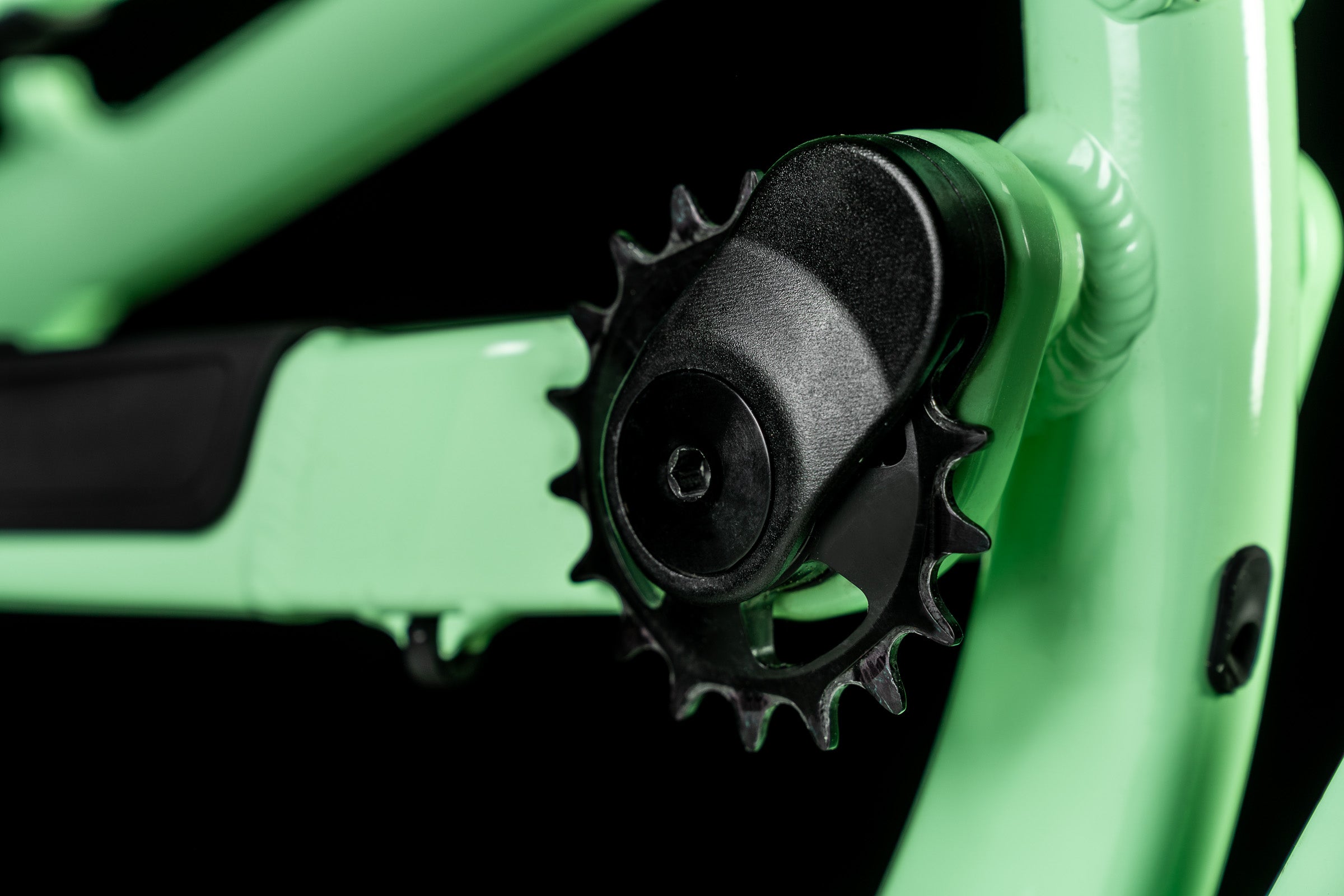
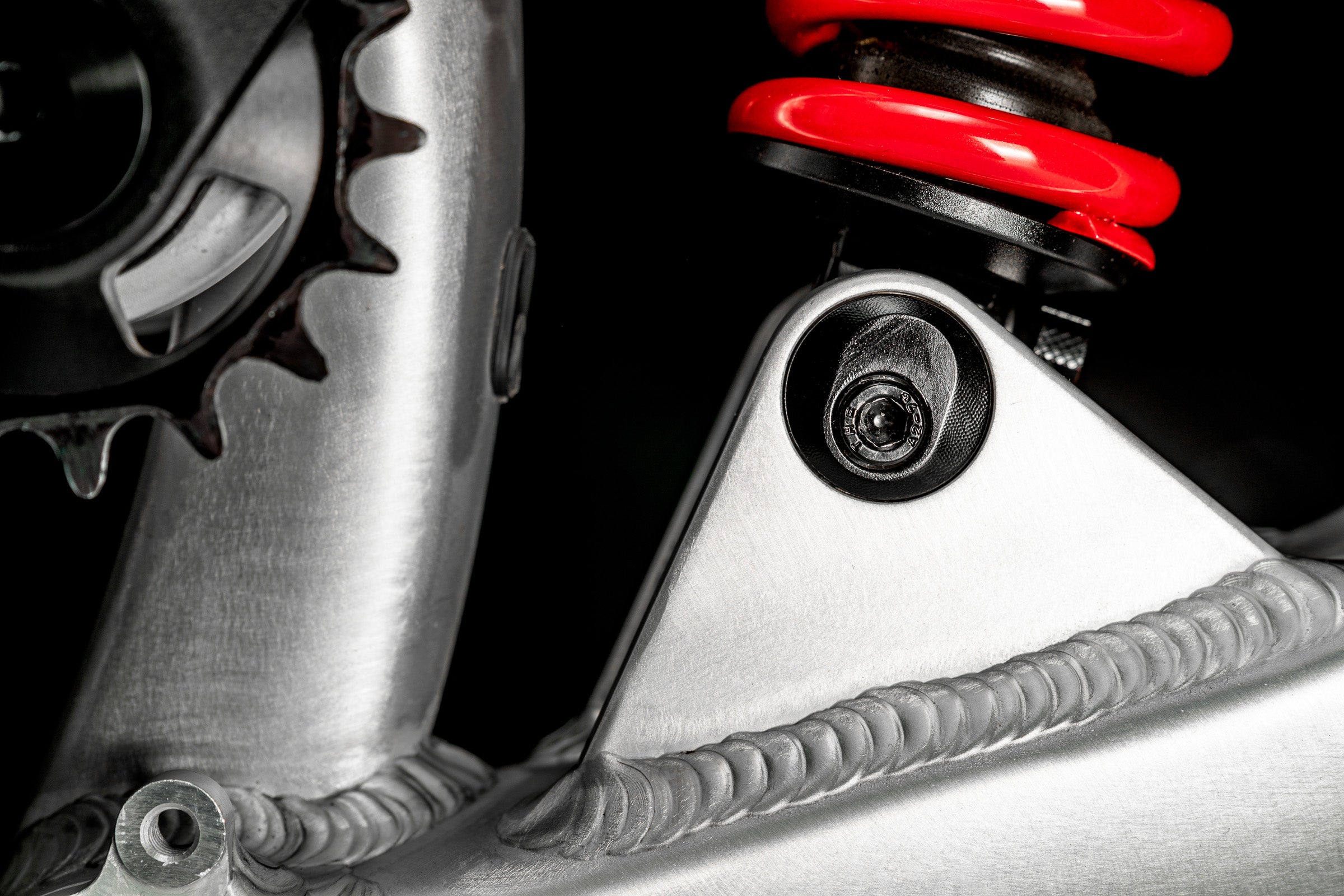
The second is i-track, a dynamic idler-pulley system licensed from Hugh McLeay in Australia. i-track puts an idler on the chainstay and routes the chain over it so the system delivers a mechanical pull-down under pedaling load while allowing a rearward axle path. The high pivot plus idler is what lets the rear wheel move up and back over square-edged hits, the same family of behavior that made high-pivot bikes like the Forbidden Druid so composed on rough descents, while the idler tames the pedal kickback that a rearward axle path would otherwise create.
Stacking CBF and i-track is the bet. The claim is that you get the square-edge absorption and reduced kickback of a high-pivot idler bike together with the balanced, consistent pedaling of a Canfield linkage. Most high-pivot bikes accept some pedaling compromise as the cost of the axle path. Taken is arguing it can have both. The leverage, axle-path, anti-squat, and anti-rise curves are published on the product page as kinematics graphs, which is more transparency than several major brands offer, even if the raw numbers behind the curves are not all listed.
The geometry Taken has shown so far
Taken has not yet released a complete per-size geometry table, which is a real gap for a geometry-focused buyer and one I will come back to. Here is what the brand and the early hands-on coverage have confirmed:
| Measurement | Value |
|---|---|
| Reach (S1 to S4) | 430mm to 505mm across the range; 480mm on the L (S3) |
| Stack (L) | 640mm |
| Head tube angle | 63.5° with a 170mm fork |
| Seat tube angle | roughly 78° effective, with straight seat tubes |
| Chainstay, 29″ rear | 437mm (S1/S2), 443mm (S3/S4) |
| Chainstay, 27.5″ rear | 431mm (S1/S2), 437mm (S3/S4) |
| Rear travel | 153 to 171mm (29″), 157 to 175mm (27.5″), set by shock stroke |
| Fork | 160 to 180mm single crown, or 180 to 190mm dual crown |
| Frame weight | 10.1 to 10.6 lb (roughly 4.6 to 4.8 kg) by size |
The headline numbers read as a modern, descent-biased enduro bike. A 63.5-degree head angle with a 170mm fork is right in the current enduro window, where most serious bikes now sit between 63 and 65 degrees. The 480mm reach on the large is on the longer side of normal but not extreme, and the 640mm stack is reasonably tall, which suits the steep effective seat angle and a body position centered for steep terrain. The straight seat tubes paired with short seat-tube lengths are the right call: they let riders run a long dropper and size by reach rather than by standover, the way most well-sorted modern enduro frames now do.
The detail I like most is the size-specific chainstays. Taken grows the rear center from 437mm on the smaller frames to 443mm on the large and XL (in 29″ trim). That is proportional geometry done correctly. A short rider on a 437mm rear and a tall rider on a 443mm rear end up with closer to the same front-center-to-rear-center balance, so both get a bike that turns and climbs with the weight distributed the way the designer intended. Brands that run one chainstay length across every size hand the tall rider a bike that feels nose-heavy and pushes through corners. As a 6’4″ rider who has spent years fighting that exact problem, I read size-specific stays as a sign the people behind a frame actually thought about fit rather than just the marketing chart.
Travel, wheels, and forks: one frame, many bikes
The Encounter is built to be reconfigured, and the adjustments are real geometry levers, not cosmetic flip chips.
Rear travel changes with shock stroke. Taken lists four shock-stroke options on a 205mm eye-to-eye shock, from 205×57.5 up to 205×65, giving 153, 159, 165, or 171mm of rear travel in 29″ trim (a touch more with a 27.5″ rear). You change travel by changing the shock, not by buying a different frame. That turns one chassis into anything from a 153mm all-rounder to a 176mm-class mini-DH rig.
Wheel size is a flip chip. The frame accepts a 29″ or 27.5″ rear wheel in every travel configuration, with a flip chip on the lower shock mount that preserves the geometry when you swap. That is the clean way to offer a mullet option: you are not forced to eat a bottom-bracket drop or a head-angle change just because you went to a smaller rear wheel. Riders chasing the mullet ride feel for tight, steep terrain get it without the usual geometry penalty.
Fork range is wide. With a DH rating and dual-crown compatibility, the frame officially takes 160 to 180mm single-crown forks or 180 to 190mm dual-crown forks. Every 10mm of added fork length slackens the head angle by roughly half a degree and raises the front, so the same frame can be set up as a 160mm single-crown all-mountain bike or a 190mm dual-crown bike park weapon. The shock menu underlines the intent: alongside RockShox Vivid Air and Coil and a Fox Float X2, Taken offers custom-tuned Push 11.6 and EXT options, which is the kind of high-end damper list you normally see on bikes costing three times as much.
If you want a refresher on how head angle, reach, chainstay, and BB height actually translate to trail behavior before you start dialing in a frame like this, the geometry explainer walks through each number and what changing it does.
Where it sits, and who should look
The Encounter is aimed squarely at the rider who wants a do-everything gravity-capable enduro bike and is comfortable building it themselves. In the current market it lands against established alloy and carbon enduro frames like the Orbea Rallon and the Specialized Enduro, but it undercuts most of them on frame price and outflanks nearly all of them on configurability. Few production enduro frames let you change travel, wheel size, and fork class on one chassis the way this one does.
For tall riders, the S4 with its roughly 505mm reach and 443mm rear is the interesting size. A 505mm reach is genuinely long, and paired with the proportional rear center it should give a 6’2″-plus rider a bike that does not feel like a stretched medium. I would want to see the full stack and wheelbase figures for the S4 before calling it a confirmed win, but the design philosophy points the right way.
The honest gaps
Two things keep the Encounter in the watch-closely column rather than the buy-now column for a data-driven buyer.
First, the geometry chart is incomplete. Taken has shared the large’s reach and stack, the head and seat angles, and the size-specific chainstays, but a full per-size table with stack, wheelbase, BB height, and head-tube length across S1 through S4 was not published at launch. For a frame whose whole pitch is configurability, the absence of a complete numbers table is the one place the transparency falls short, and it is the first thing I would ask the brand to fix.
Second, this is a frame-only, direct-to-consumer launch from a first-year company with no dealer network and no long-term reliability record. The shock options are excellent and the contract builder is reputable, but you are an early adopter. The kinematics graphs are published, the patents are real, and the price is honest. Whether the combined CBF and i-track platform rides as well as the math suggests is something the first season of owners will tell us.
What the Encounter already proves is that a four-person brand from Boise can license two of the more interesting suspension ideas in mountain biking, wrap them in proportional, descent-ready geometry, and ship it for less than the cost of most carbon frames. That is a genuinely new entry in the enduro category, and it is exactly the kind of bike worth measuring as the full numbers come out.
Sources: Taken Cycles Encounter product page, Vital MTB press release, The Loam Wolf Dissected, and BikeMag.