
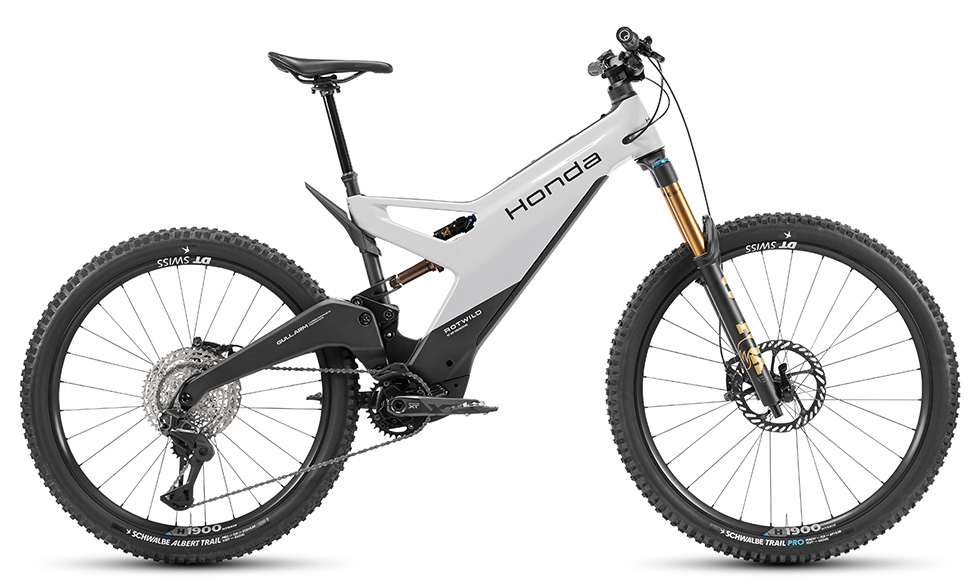
The last mountain bike Honda built was never for sale. The RN01 downhill bike ran a gearbox sealed inside the frame and an upside-down KYB fork, and Greg Minnaar raced it at the sharp end of the World Cup before the program disappeared. Today, at EICMA in Milan, Honda unveiled the RN0: its first production mountain bike, a carbon eMTB codeveloped with German brand ROTWILD and powered by an unreleased Shimano motor.
The Honda RN0 geometry is conservative, compact and, in places, a few seasons behind the bikes it will be shopped against. That is not automatically a flaw. It depends on who walks into the shop, and in this case the shop is a Honda motorcycle dealer.
The full Honda RN0 geometry chart

Honda’s European press kit lists three sizes. Angles, chainstay and bottom bracket figures are identical across all of them.
| Measurement | S | M | L |
|---|---|---|---|
| Reach | 430mm | 455mm | 480mm |
| Stack | 631mm | 640mm | 649mm |
| Head tube angle | 65° | 65° | 65° |
| Effective seat tube angle | 76.5° | 76.5° | 76.5° |
| Chainstay | 442mm | 442mm | 442mm |
| BB height | 345mm | 345mm | 345mm |
| BB drop | 20mm | 20mm | 20mm |
| Wheelbase | 1,201mm | 1,230mm | 1,259mm |
| Effective top tube | 582mm | 609mm | 636mm |
| Head tube | 105mm | 115mm | 125mm |
| Seat tube | 428mm | 435mm | 452mm |
| Standover | 773mm | 774mm | 777mm |
| Dropper travel | 125mm | 150mm | 170mm |
The frame is a single-piece carbon monocoque with what Honda calls a Gullwing swingarm, driving a Fox Float X Factory shock through a linkage for 145mm of rear travel. Up front is a 160mm Fox 36 Factory GRIP X2. Wheels are mixed: 29 inches front, 27.5 inches rear, on DT Swiss H1900 rims with Schwalbe Albert tyres.
Reach climbs a tidy 25mm per size, stack only 9mm. Every size gets the same 442mm chainstay. An optional Acros MOD66 headset cup kit shifts the head angle by 0.6 degrees and reach by 5mm in either direction, but only on the M and L frames.
Why do testers say the RN0 feels tall?

Three separate first rides landed on the same word. Vital MTB found it felt tall at times and was harder to load into turns. E-MOUNTAINBIKE blamed the high bottom bracket (and a short 150mm dropper on their size M) for a riding position that felt less integrated. BIKE magazine described it as standing on the bike rather than in it.
The chart only partly explains that. A 345mm BB height is not extreme for a mixed-wheel eMTB; Kona lists 350mm on the Remote 160. The 20mm BB drop matters more. Because the rear axle sits on a smaller 27.5-inch wheel, the drop figure reads shallower than it would on a full 29er, and the rider’s feet sit closer to axle height than the head angle suggests.
Then there is the front end. The RN0’s 65 degree head angle was the trail-bike default a few years ago, but our 2026 geometry trends roundup found the average trail head angle has slackened to 64.8 degrees, and the two eMTBs compared below sit at 64 and 63.5 degrees. With a short 105 to 125mm head tube and modest stack, the RN0 places the bars low and close while the bottom bracket stays up. That combination is what “on the bike” feels like.
What does a 76.5-degree seat angle change on a climb?
This is the number on the chart that stands out most against current eMTBs. The Kona Remote 160 runs 78.3 degrees on a size L; Canyon’s Spectral:ON CF 9 runs 78.5.
Two degrees sounds small. At a typical 760mm saddle height for a size L rider, the difference between 76.5 and 78.5 degrees moves the saddle roughly 26mm further behind the bottom bracket (760 × (cos 76.5° minus cos 78.5°)). Pair that with a 442mm chainstay that does not grow with frame size, and the rider’s weight sits further rearward relative to the rear axle on steep pitches.
BIKE magazine noticed exactly that: on steep climbs the rider had to lean forward to keep the front wheel planted. On an eMTB with 100Nm on tap, front-wheel lift is the limiting factor on technical climbs long before leg strength is. Honda and ROTWILD chose a more upright, touring-friendly position; the cost shows up when the trail points sharply up.
Can a 6’4″ rider fit the size L?
Short answer, from my side of the tape measure: not comfortably.
At 6’4″ I look for reach in the 500 to 520mm range and stack above 650mm on a long-travel bike. The RN0’s largest frame tops out at 480mm reach and 649mm stack. Even with the MOD66 cups in the long setting, reach only stretches to about 485mm, and Honda offers no XL. The 170mm dropper on the L also runs out early for a 36-inch inseam, which E-MOUNTAINBIKE flagged as too short even on the medium.
The fixed chainstay compounds it. On the size S, the 442mm rear centre is 36.8% of the 1,201mm wheelbase; on the L it drops to 35.1% of 1,259mm. Larger riders get proportionally less rear centre, so a tall rider on an L ends up with a cramped front and a short rear at the same time. We have seen the same fixed-chainstay approach on Cube’s 2027 Stereo, but Cube at least sizes up to XL.
Honda publishes no rider height ranges, but on these numbers I would put the realistic fit window at roughly 5’5″ to 6’1″. Vital’s tester is 6’0″ and Singletrack’s rode the L; neither reported fit problems, which is consistent with that range.
How it lines up against two current eMTBs
Size L on all three, stock settings:
| Measurement (size L) | Honda RN0 | Kona Remote 160 | Canyon Spectral:ON CF 9 |
|---|---|---|---|
| Reach | 480mm | 480mm | 495mm |
| Stack | 649mm | 646mm | 650mm |
| Head angle | 65° | 63.5° | 64° |
| Seat angle | 76.5° | 78.3° | 78.5° |
| Chainstay | 442mm | 445mm | 447mm |
| Wheelbase | 1,259mm | 1,283mm | 1,293mm |
| Travel (F/R) | 160/145mm | 170/160mm | 160/155mm |
| Motor torque | 100Nm | 120Nm | 150Nm |
| Largest size | L | XL | XL |
The Kona is the cleanest comparison: identical 480mm reach, nearly identical stack. Yet the Kona’s wheelbase is 24mm longer, almost entirely in the front centre, because its head angle is 1.5 degrees slacker. That is the difference between a bike built to be stable at speed and one built to turn easily at moderate speed. E-MOUNTAINBIKE and BikeRadar both called the RN0 agile and playful; BikeRadar also judged it “not as composed” as rivals, which is what the shorter front centre predicts.
The motor, the weight and the price
The RN0 is the first bike to show Shimano’s next drive unit: 100Nm and 750W peak from a 2.3kg motor, with assistance up to 160rpm cadence against the EP801’s 120rpm. BikeRadar reports it is 300g lighter than the previous generation but felt a generation or two behind the Avinox M2S and Bosch Performance Line CX on pre-production firmware. For where that sits in the wider market, see our eMTB motor and drive system comparison.
Battery is a 720Wh Shimano unit that swings out of the down tube. Claimed weight is 23.5kg in Honda’s European kit, with Vital and BIKE quoting about 24kg. Canyon’s Spectral:ON CF 9 carries 150Nm and still weighs 21.7kg in a size M. We dug into what those extra kilos cost on the trail in our eMTB weight versus power analysis.
Honda has not published official pricing. Vital reports roughly €10,000, varying by country, which would put the RN0 about €3,000 above the Spectral:ON CF 9’s €6,999.
So who is it for?
Not the rider shopping geometry charts. Singletrack said it bluntly: “We are not the target market here.”
The RN0 will be sold and serviced through selected Honda motorcycle dealers in Europe first, with bicycle retailers mentioned only as a future possibility. Its customer is most likely someone who already owns a Honda, trusts the dealer, and wants an eMTB for long all-mountain tours rather than timed descents. For that rider, an upright 76.5 degree seat angle, a 65 degree head angle that steers predictably and dealer-backed service are reasonable priorities.
For everyone else, the numbers say the same thing the testers did: a competent 145mm trail eMTB with a short size range, a slack-ish seat angle and a premium price for a badge. If you are over 6’1″, the chart answers the question before the test ride does.